Abstract
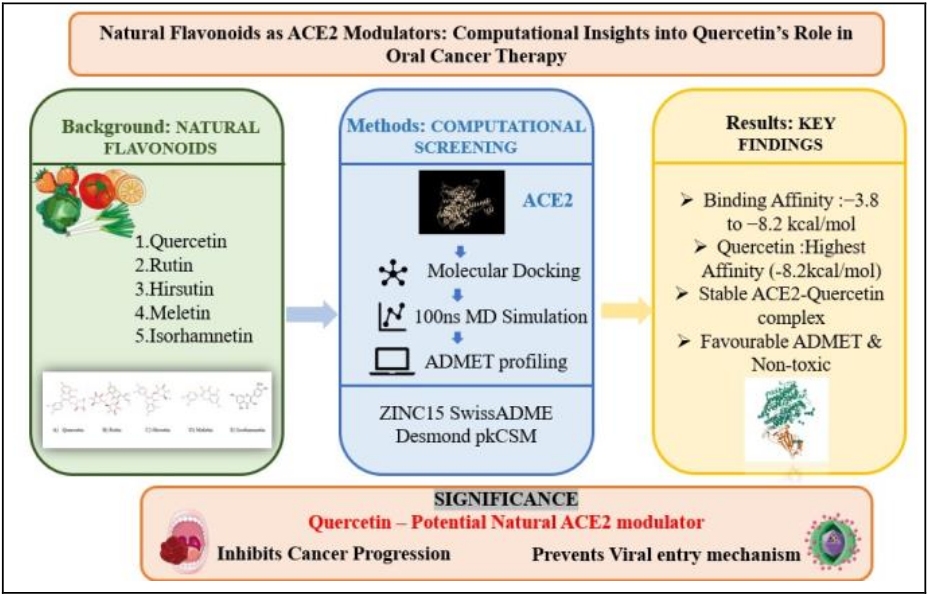
Background: Angiotensin-converting enzyme 2 (ACE2) is a key counter-regulatory enzyme in the Renin-Angiotensin System that converts angiotensin II into angiotensin-1–7, which has anti-inflammatory, antifibrotic, and vasodilatory properties. In addition to its cardioprotective function, ACE2 has gained attention in the field of cancer biology, where the dysregulated ACE2/Ang-(1–7)/Mas axis links its downregulation to tumour progression and poor prognosis, including in Oral Squamous Cell Carcinoma (OSCC) the predominant cancers of the head and neck region, which accounts for about 90%, with approximately 270,000 to 300,000 new cases diagnosed world-wide each year, and about 20% occurring in people less than 55 years. Its clinical significance is further emphasized by its role as the SARS-CoV-2 entry receptor; ACE2 expression is influenced by a number of hormones, but little is known about the role of antioxidants. By interacting with signalling pathways, quercetin, a bioflavonoid derived from plants, may alter ACE2. This study analyses the potential effects of quercetin on ACE2 by means of computational methods. Materials & methods: Molecular docking, interaction profiling, molecular dynamics (MD) modeling, and in silico ADMET analysis were employed to investigate ligand–protein interactions with ACE2. Top-ranked ZINC library chemicals were docked to ACE2 to identify favorable binding conformations. Binding affinities were assessed using a variety of scoring systems. MD simulations using Desmond were performed for 100 ns in order to evaluate the ACE2-ligand complexes' dynamic behavior and structural stability under physiological settings. Through interaction profiling, strong conformational alterations and binding persistence were found. To evaluate quercetin's pharmacokinetics, drug-likeness, and toxicity, ADMET predictions were also made using the pkCSM program. Results: With a docking score of -8.2 kcal/mol, quercetin demonstrated a high binding affinity with ACE2. MD simulations showed complex stability with few fluctuations. Persistent ligand-receptor binding was validated by interaction profiling. Conclusion: The research aims to provide insights for future experimental validations and to stimulate the development of bioflavonoid Quercetin as a novel, effective therapeutic agent for modulating the ACE2 activity.
Graphical Abstract