Abstract
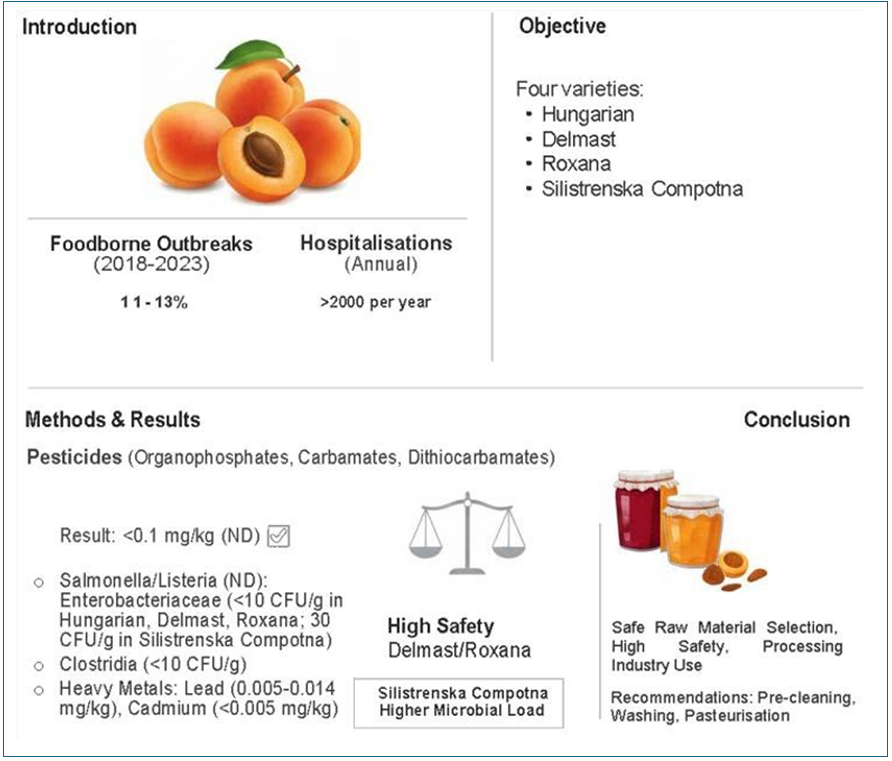
Introduction: Apricots are a valuable raw material for the production of jams, juices, and dried products; however, their safety largely depends on residual contaminants. According to recent epidemiological data from the European Food Safety Authority (EFSA), foodborne outbreaks linked to contaminated fruits and vegetables accounted for approximately 11-13% of total cases of foodborne illness in the European Union between 2018 and 2023, with pathogens such as Salmonella spp. and Listeria monocytogenes responsible for over 2,000 hospitalisations annually. Objective: The aim of this study was a comprehensive assessment of the safety of fresh apricot fruits (Prunus armeniaca L.) from four varieties – Hungarian, Delmast, Roxana, and Silistrenska Compotna – grown in Bulgaria, in terms of compliance with the sanitary and hygienic requirements of the European Union. Methods: The study included the determination of pesticide residues from three toxicological groups, quantitative and qualitative microbiological assessment, and measurement of heavy metal content. Results: In all samples, the concentrations of organophosphates, carbamates, and dithiocarbamates were below the limit of quantification (0.010 mg/kg), confirming that the maximum permissible levels were not exceeded. Salmonella spp. and Listeria monocytogenes was not detected in any sample. The Enterobacteriaceae count was <10 CFU/g in the Hungarian, Delmast, and Roxana varieties, but reached 30 CFU/g in Silistrenska Compotna. All samples showed low levels of sulphite-reducing Clostridia (<10 CFU/g). Lead content ranged from 0.005 mg/kg in Delmast to 0.014 mg/kg in Hungarian, while cadmium did not exceed 0.005 mg/kg in any sample. Comparative analysis showed the highest overall safety in the Delmast and Roxana varieties, while the Silistrenska Compotna variety, despite acceptable concentrations of heavy metals and pesticides, was found to have a higher microbiological load. Conclusions: The results can be used for the selection of safe raw materials in the processing industry, as well as for the development of recommendations for pre-cleaning, washing, or pasteurisation of certain varieties prior to technological processing.
Graphical Abstract