Abstract
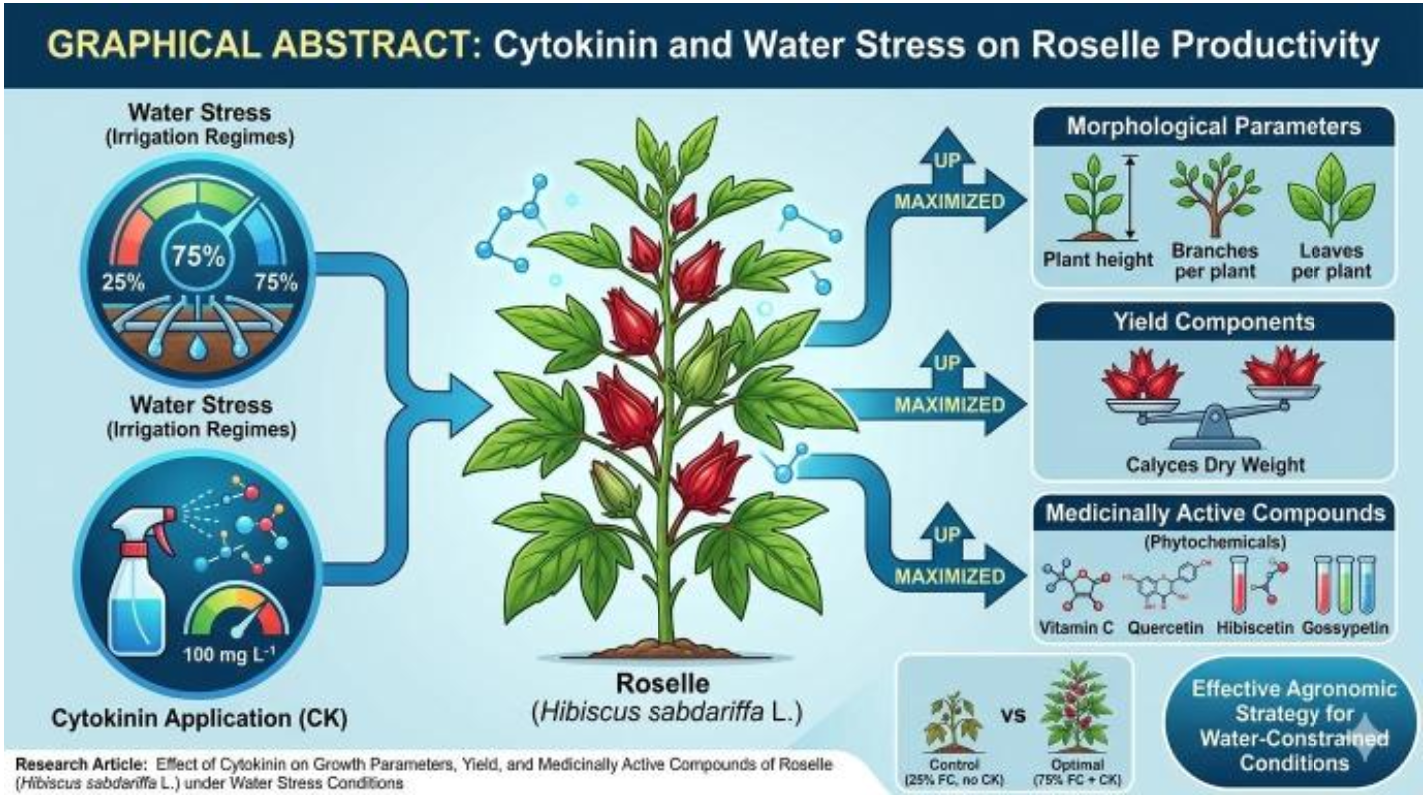
Introduction: Water stress significantly limits the agricultural and medicinal potential of roselle (Hibiscus sabdariffa L.). Exogenous plant growth regulators, such as cytokinins, may mitigate these adverse environmental effects and enhance overall plant productivity. Objective: To investigate the impact of cytokinin application and varying water stress levels on the vegetative growth, yield, and medicinally active compounds of roselle. Methods: A factorial field experiment using a Randomized Complete Block Design (RCBD) with three replications was conducted during the spring season of 2025 in Al-Mussaib, Iraq. Treatments consisted of three cytokinin levels (0, 50, and 100 mg L⁻¹) and four water stress levels (25%, 50%, 75%, and 100% of field capacity). Data were statistically analyzed using the Least Significant Difference (LSD) test. Results: The application of 100 mg L⁻¹ cytokinin significantly maximized plant height (95.08 cm), branches (9.20 plant⁻¹), leaves (106.70 plant⁻¹), capsules (38.83 plant⁻¹), and calyces’ dry weight (9.30 g). It also peaked the concentrations of vitamin C, quercetin, hibiscetin, and gossypetin. Similarly, irrigation at 75% field capacity produced the highest mean values for the same traits. Crucially, the interaction between 100 mg L⁻¹ cytokinin and 75% field capacity recorded the absolute highest values across all studied morphological, yield, and phytochemical parameters. Conclusions: Applying 100 mg L⁻¹ of cytokinin optimally enhances the growth, yield, and phytochemical composition of Hibiscus sabdariffa L., particularly when combined with
moderate water management (75% field capacity). This combination provides an effective agronomic strategy for cultivating this medicinal crop under constrained water conditions.
Graphical Abstract