Abstract
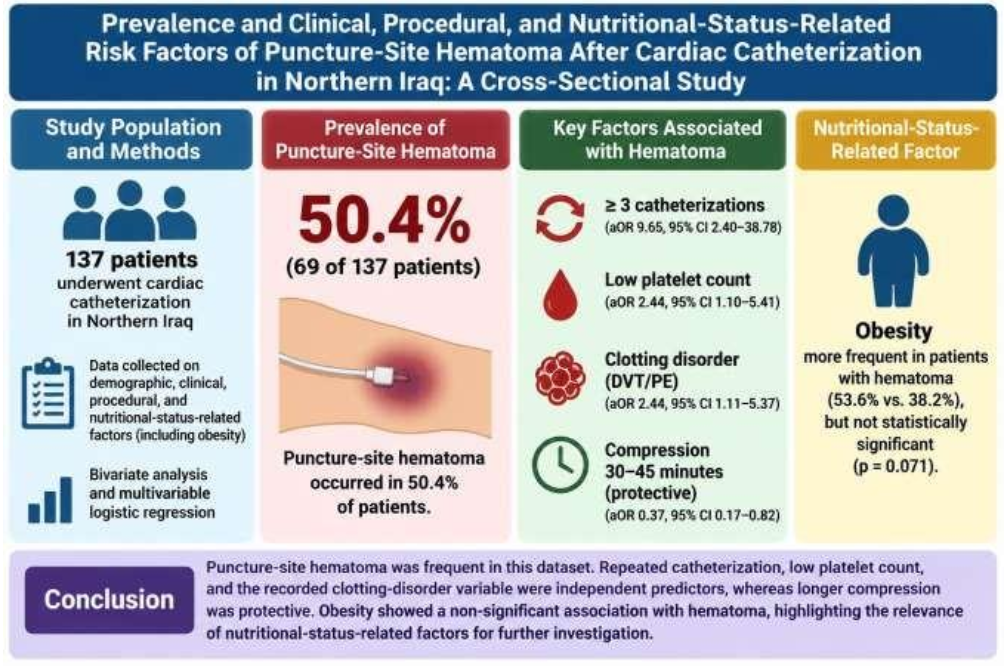
Introduction: Puncture-site hematoma is a clinically relevant vascular-access complication after invasive catheter-based procedures. Objective: This study aimed to determine the prevalence of puncture-site hematoma and identify its associated risk factors including nutritional-status-related factors among patients following cardiac catheterization in Northern Iraq. Methods: Data from 137 patients were analyzed using a structured data-collection form covering demographic and clinical characteristics, catheterization-related variables, 16 potential risk factors, including obesity as a nutritional-status-related factor, and clinical signs and symptoms. Categorical data were summarized as frequencies and percentages. Pearson chi-square tests were used for bivariate associations, and variables significantly associated with hematoma were entered into a multivariable binary logistic regression model. Odds ratios (ORs) with 95% confidence intervals (CIs) were reported. Results: Puncture-site hematoma occurred in 69 of 137 patients (50.4%). Obesity was more frequent among patients with hematoma than those without hematoma (53.6% vs. 38.2%), although the association was not statistically significant (p=0.071). In bivariate analysis, hematoma was associated with three or more cardiac catheterizations (p=0.001), femoral versus radial access (p=0.033), shorter compression time (15–30 minutes; p=0.013), a history of inherited/acquired clotting disorder recorded as DVT/PE (p=0.002), and low platelet count (p=0.012). In the adjusted model, clotting disorder (aOR 2.44, 95% CI 1.11–5.37), low platelet count (aOR 2.44, 95% CI 1.10–5.41), and three or more catheterizations (aOR 9.65, 95% CI 2.40–38.78) were associated with greater odds of hematoma. Compression for 30–45 minutes was associated with lower odds (aOR 0.37, 95% CI 0.17–0.82). Radial access showed a protective direction but did not remain statistically significant after adjustment (aOR 0.48, p=0.079). Conclusion: Puncture-site hematoma was frequent in this dataset. Repeated catheterization, low platelet count, and the recorded clotting-disorder variable were independent predictors, whereas longer compression was protective. Obesity showed a non-significant association with hematoma, highlighting the relevance of nutritional-status-related factors for further investigation. Risk stratification and careful post-procedural hemostasis and monitoring should be emphasized in cardiac catheterization care.
Graphical Abstract