Abstract
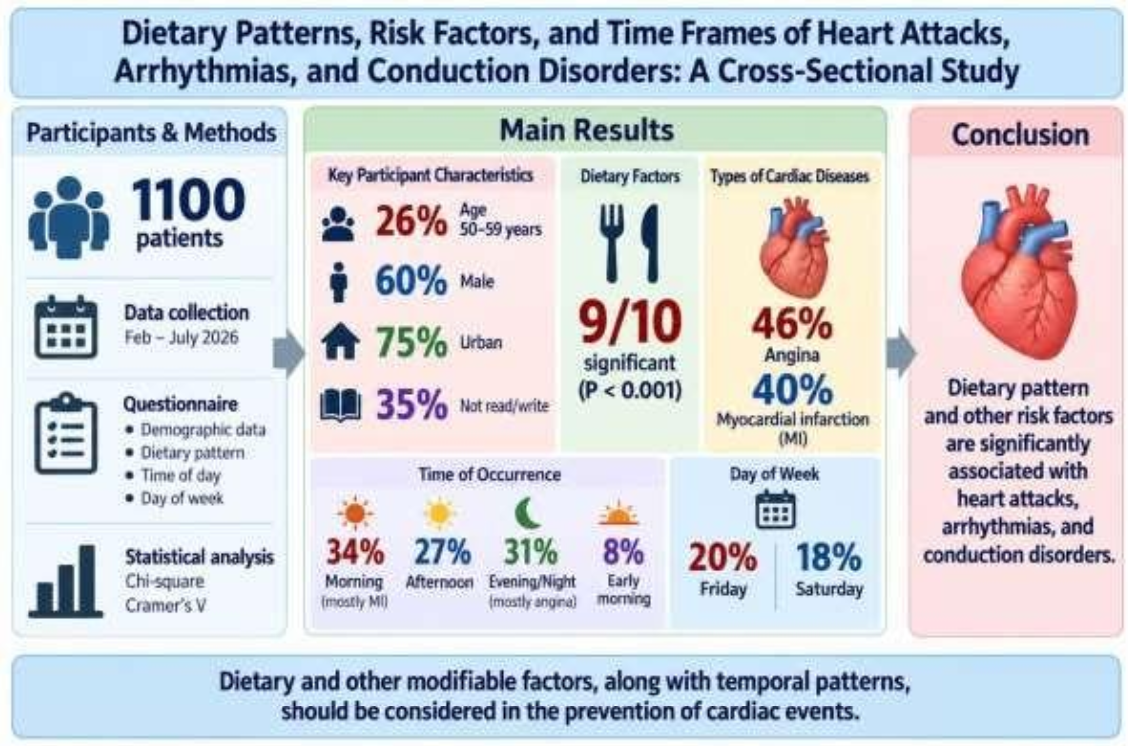
Introduction: Cardiovascular diseases (CVDs) represent the leading cause of dying cases globally and embody a major public health obstacle. They involve IHD, heart failure, arrhythmias, and electrical conduction disorders, that contribute basically to hospitalization, morbidity, and mortality. The global burden has been related to people ageing and the increasing prevalence of CVDs risk factors. Approximately 19.8 million deaths were related to CVDs globally during 2022. Objective: It was to identify dietary and other risk factors and time frames of heart attacks, arrhythmias, and conduction disorders. Methods: A descriptive study were carried out to achieve the objectives of the study. A non-probability convenience sampling method was used to select (1100) patients that diagnosed with cardiac diseases by the medical staff in CCU of both Kirkuk Teaching Hospital and Azadi teaching Hospital in Kirkuk’s city and to achieve the objectives of the study. The data were collected for a period from 1 February through 31 Juley 2026 through an interviewer – administered questionnaire in which constructed for the study that consisted of parts I, demographic data (risk factors), part II, dietary pattern of the participants. part III, cardiac diseases occurrence according to the times of day, part IV, cardiac events according to days of week. A content validity was obtained to review the items relativeness of the tool. Reliability of the questionnaire rated (0.81). The data were analyzed by using descriptive and inferential statistical data analysis including (frequencies, percentage, Pearson Chi-square, Cramer's v test, Monte-Carlo test and Chi-Square Goodness-of-Fit Test). Results: The findings of the study showed risk factors related demographic data that most of the sample were from age group (50-59) years which represent (26%), male percentage was (60%) compared to female (40%), marred cases accounted (66%), not read/write (35%), lived in urban (75%), housewife represented patients (40%) . Also, the study reported that most of the participants had angina (46%) followed by MI (40%). Furthermore, majority (9 out of 10) of the items were highly significant (p < 0.001) in regard to dietary factor. In addition, cardiac diseases and arrhythmia was occurred highly during morning (34%) mostly among MI cases (17%) and evening/night (31%) most of them had angina (19%). 20% take place on Friday and (18%) 0n Saturday. Relationship between cardiac conditions and time of occurrence showed a moderate significant association for both time of day and day of week (p<0.001). Conclusions: The study concluded that risk factors of cardiac diseases involved individuals with age group (50-59) years old , males, married, unable to read/ write, urban resident and housewives. Furthermore, dietary pattern was highly significant factor for cardiac diseases, arrhythmias and conduction disorders. In addition, cardiac diseases occurred during Sunday and Fridays regarding MI whereas Angina on Saturday, and a clear increase in incidence during morning and evening hours. A moderate significant association was observed between cardiac conditions and time frame according to time (hours) of day and days of week.
Graphical Abstract