Abstract
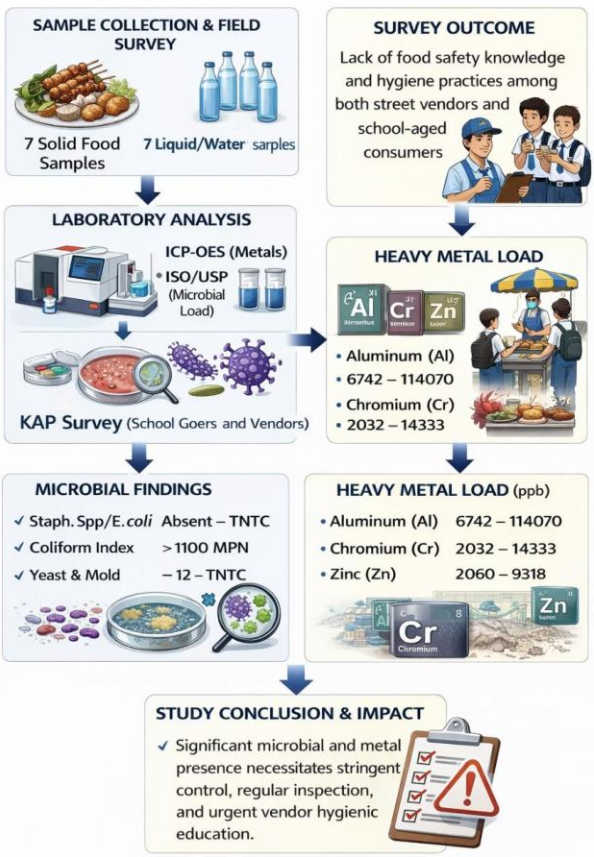
Substandard and improper food hygiene of street food can lead to human ailments by dangerous pathogens and heavy metals. 33% of commonly consumed street food samples including pickles, sauces, chips, puffed rice, fruit drinks, mustard oil, butter, soybean oil, dalda, and honey have been tested unsafe in Bangladesh. The objective of this study is to evaluate the microbiological quality and heavy metal level of several street items predominantly consumed by school-aged children in Cumilla city, Bangladesh. Collected street food samples were promptly processed and dispatched to the laboratory. The microbial load and heavy metal concentration were evaluated using standard microbiological testing techniques and the Inductively Coupled Plasma Optical Emission Spectrometry (ICP-OES) method, respectively. The knowledge, behaviors, and attitudes of food vendors and consumers on street foods were assessed with a questionnaire derived from prior research. The survey results showed that both street food vendors and consumer lack food safety knowledge. The microbial test revealed the presence of different microorganisms in the range of: Staphylococcus spp (absent- too numerous to count, TNTC), Pseudomonas spp (absent- TNTC), Coliform (>1100 MPN index/100g), E.coli (absent- TNTC), Yeast and Mold (12 cfu/g -TNTC). In solid food items, concentration (ppb) of selected metals was: Al (6742-114070), Zn (2060- 9318), Cr (2032-14333), Cd (<dL, dL=5), Cu (999-3773), Ni (1501-2024). Drinking jar water contained microbial load and heavy metals within the permissible range. It is imperative to instruct and teach our merchants on proper hygienic standards at the local level. The substantial microbiological and heavy metal presence necessitates stringent control through regular inspection and monitoring.
Graphical Abstract