Abstract
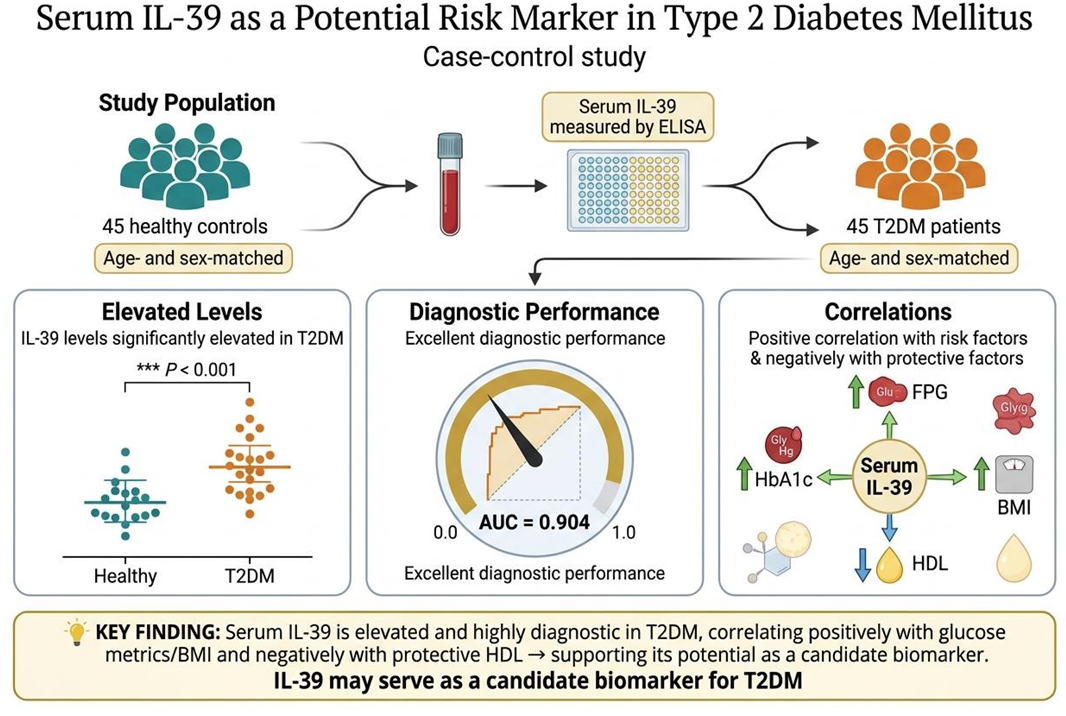
Introduction: Type 2 diabetes mellitus (T2DM) is a heterogeneous metabolic disorder characterised by chronic hyperglycaemia resulting from defects in insulin secretion, insulin action, or both, leading to long-term damage of multiple organ systems, including the kidneys, retina, nervous system, heart, and blood vessels. Interleukin-39 (IL-39) is a novel heterodimeric member of the IL-12 cytokine family that may participate in the pathogenesis of human inflammatory disorders. Because T2DM is characterised by chronic low-grade inflammation, IL-39 may be a relevant cytokine whose pathogenic involvement in the disease warrants investigation. Objective: The present study aimed to evaluate the role of serum interleukin-39 in patients with type 2 diabetes mellitus. Materials and Methods: A case-control study was conducted in which serum IL-39 levels were measured in 45 patients with type 2 diabetes mellitus (T2DM) and 45 age- and sex-matched healthy controls. Biochemical measurements included fasting plasma glucose (FPG), glycosylated haemoglobin (HbA1c), total cholesterol, triglycerides, high-density lipoprotein (HDL), and low-density lipoprotein (LDL), measured using spectrophotometric enzymatic colorimetric methods. Serum IL-39 was quantified using an enzyme-linked immunosorbent
assay (ELISA) kit. Results: The mean serum IL-39 level was significantly higher in patients than in controls (11.21 ± 2.38 ng/mL vs. 7.42 ± 1.76 ng/mL; p < 0.001). Serum IL-39 showed a significant positive correlation with FPG (r = 0.298, P = 0.005), HbA1c (r = 0.499, p < 0.001), and body-mass index, and a significant negative correlation with HDL (r = –0.367, p < 0.001). Receiver-operating-characteristic (ROC) curve analysis of serum IL-39 yielded a cut-off value of 8.975 ng/mL, an area under the curve of 0.904, sensitivity of 0.844, specificity of 0.820, and p < 0.001. Conclusion: Serum IL-39 levels were significantly elevated in patients with T2DM and correlated positively with markers of glycaemic control. ROC analysis demonstrated excellent diagnostic performance of IL-39 in distinguishing T2DM patients from healthy controls. These findings suggest that IL-39 may serve as a potential novel biomarker for T2DM.
Graphical Abstract