Abstract
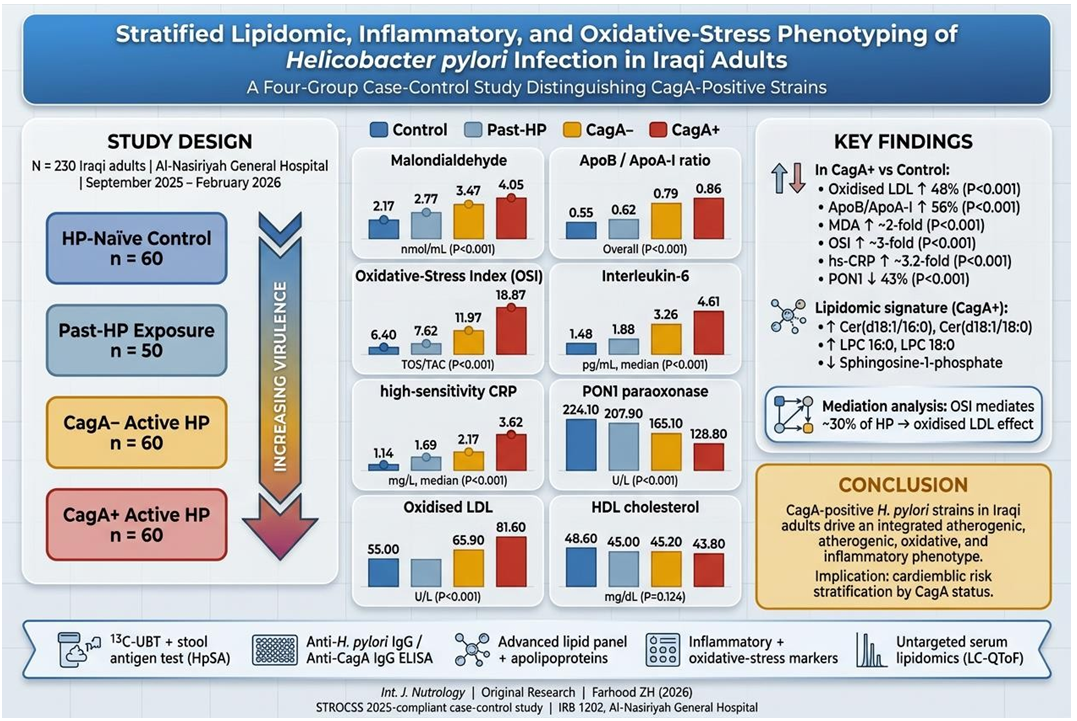
Introduction: Helicobacter pylori is increasingly implicated in extragastric metabolic and atherogenic disease, but human data integrating advanced lipidomics, oxidative-stress biology, and high-density lipoprotein (HDL) functional assessment in a CagA-stratified design remain scarce, particularly in the Middle East. Objective: To characterize variations in lipid metabolism across stages of H. pylori exposure, distinguishing virulent CagA-positive strains, and to identify the biological pathways mediating this relationship. Methods. In this STROBE-compliant case– control study (Al-Nasiriyah General/Turkish Hospital, Dhi Qar, Iraq; September 2025–February 2026), 230 adults aged 18–60 years were assigned to four pre-specified groups: H. pylori-naïve controls (n=60), past H. pylori exposure (n=50), active CagA-negative infection (n=60), and active CagA-positive infection (n=60), based on ¹³C-urea breath testing, stool antigen testing, and anti-H. pylori/anti-CagA serology. Conventional and advanced lipoproteins, apolipoproteins, atherogenic indices, inflammatory cytokines, oxidative-stress and antioxidant markers, HDL-functional enzymes, adipokines, insulin axis, one-carbon biomarkers, and an untargeted serum lipidomic panel were measured. Multivariable linear regression, ROC analysis with bootstrap-validated LASSO modeling, and bootstrap mediation analyses were performed. Results: A monotonic gradient (Control → Past-HP → CagA− → CagA+) was observed for atherogenic, inflammatory, and oxidative biomarkers, with reciprocal declines in apolipoprotein A-I, paraoxonase-1, lecithin– cholesterol acyltransferase, adiponectin, and antioxidant capacity. After adjustment for age, sex, BMI, smoking, diet, physical activity, and inflammation, CagA+ infection was independently associated with elevated oxidized LDL, ApoB/ApoA-I ratio, atherogenic index of plasma, and reduced PON1 activity (all P<0.001). Lipidomics revealed elevated saturated ceramides and lyso-phosphatidylcholines with depleted sphingosine-1-phosphate. Oxidative-stress index and inflammation partially mediated the H. pylori–lipid associations. Conclusion: H. pylori infection, particularly with CagA+ strains, is independently associated with an adverse lipid metabolic, lipidomic, and HDL-functional phenotype mediated in part by inflammation and oxidative stress.
Graphical Abstract