Abstract
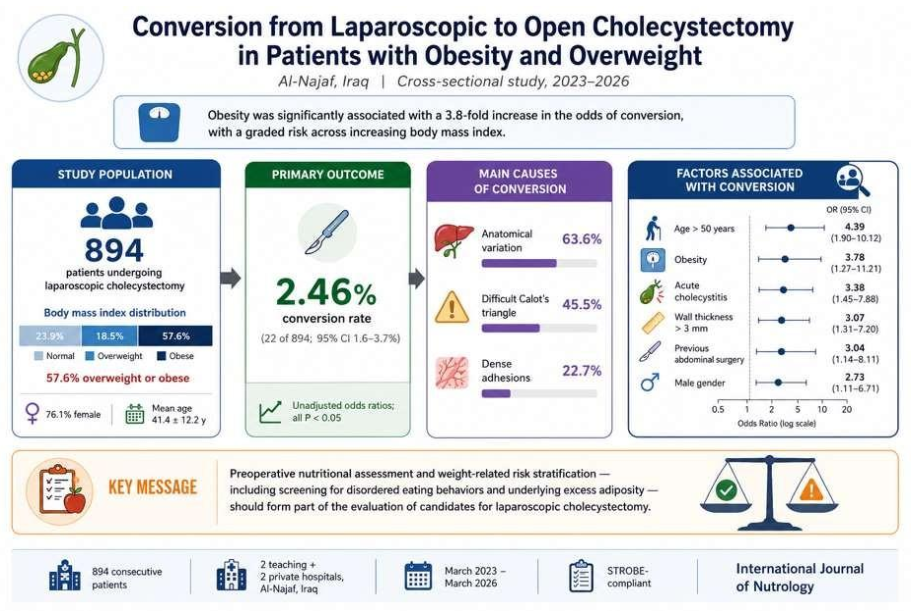
Introduction: Laparoscopic cholecystectomy is the gold-standard treatment for symptomatic cholelithiasis. Obesity and overweight - conditions central to nutrology and frequently linked to disordered eating patterns and altered nutritional status - are common among these patients and may complicate the laparoscopic approach, occasionally necessitating conversion to open surgery to preserve patient safety. Objective: To estimate the rate of conversion from laparoscopic to open cholecystectomy, to identify the main causes of conversion, and to assess contributing factors - with particular attention to obesity and overweight - among Iraqi patients. Methods: This cross-sectional study, reported in accordance with the Strengthening the Reporting of Observational Studies in Epidemiology (STROBE) statement, included 894 Iraqi patients of both genders with symptomatic cholecystitis undergoing laparoscopic cholecystectomy at two governmental teaching hospitals and two private hospitals in Al-Najaf, from March 2023 to March 2026. All eligible patients operated on during the study period were enrolled consecutively (total enumeration); this sample exceeded the calculated minimum of 416 patients and estimated the conversion rate with an absolute precision of ±1.0 percentage point at the 95% confidence level. Body mass index was classified per World Health Organization criteria. Unadjusted odds ratios (OR) with 95% confidence intervals (CI) were calculated; P < 0.05 was significant. Results: Of 894 laparoscopic cholecystectomies, 22 required conversions (rate 2.46%; 95% CI 1.63–3.70%). Overweight (34.3%) and obese (23.3%) patients constituted the majority of the cohort. Causes of conversion were anatomical variation/anomalies (63.6%), difficult Calot's triangle (45.5%), dense adhesions (22.7%), uncontrollable bleeding (9.1%) and bile duct injury (4.5%). Obesity was significantly associated with conversion (OR = 3.78; 95% CI: 1.27–11.21). Additional associated factors were age > 50 years (OR = 4.39; 95% CI: 1.85–10.41), male gender (OR = 2.73; 95% CI: 1.16–6.40), previous abdominal surgery (OR = 3.04; 95% CI: 1.21–7.62), acute cholecystitis (OR = 3.38; 95% CI: 1.29–8.87) and gallbladder wall thickness > 3 mm (OR = 3.07; 95% CI: 1.26– 7.44). Conclusion: The conversion rate of 2.46% lies within the lower international range. Obesity and overweight are prevalent and clinically relevant in this surgical population, and obesity was significantly associated with conversion. These findings support the inclusion of nutritional assessment and weight-related risk stratification — including screening for disordered eating behaviors that contribute to excess adiposity — in the preoperative evaluation of candidates for laparoscopic cholecystectomy. Because the analysis was bivariate and the number of conversion events was small, these associations should be regarded as hypothesis-generating and require confirmation in larger studies with multivariable adjustment.
Graphical Abstract