Abstract
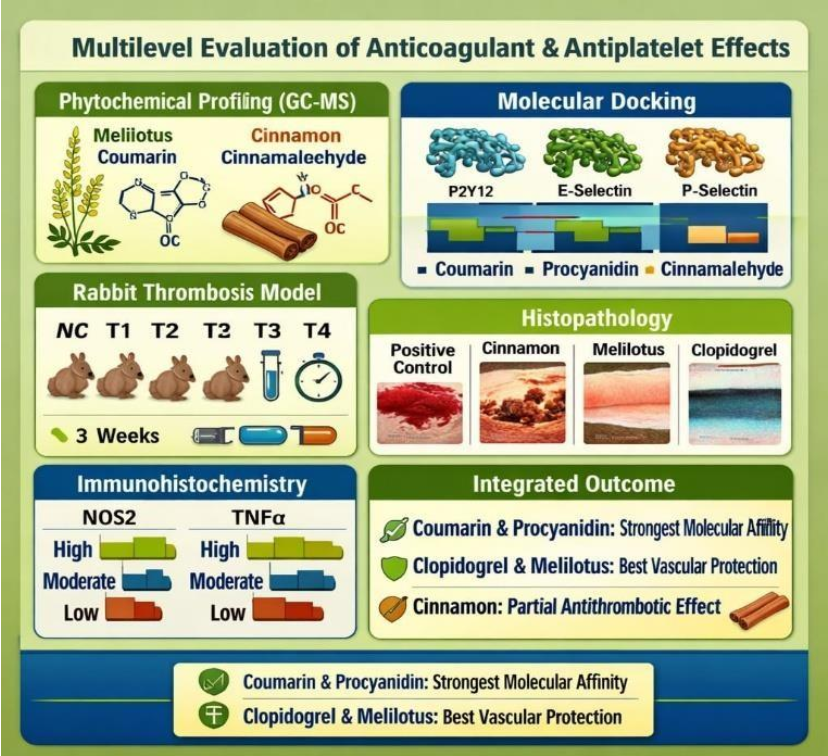
The molecular docking analysis demonstrated that coumarin consistently exhibited the strongest binding affinities across all thrombo-inflammatory targets (P2Y12 receptor, E-selectin, and P-selectin), with binding energies ranging from –8.1 to –8.7 kcal/mol and multiple hydrogen bonds and hydrophobic contacts. Procyanidin showed intermediate efficacy, forming extensive hydrogen-bond networks and favorable binding energies (–7.2 to –7.9 kcal/mol), while cinnamaldehyde displayed the weakest interactions (–5.7 to –6.3 kcal/mol), limited by its smaller molecular size. Histological studies confirmed that clopidogrel and Melilotus officinalis reduced thrombus formation and collagen deposition, while cinnamon exhibited partial protective effects but still showed significant thrombus presence. Immunohistochemistry revealed that clopidogrel suppressed NOS2 and TNF-α expression, Melilotus reduced oxidative stress and inflammation, and cinnamon moderately decreased TNF-α but maintained high NOS2 activity. Overall, coumarin and procyanidin demonstrated superior predicted binding affinity, while clopidogrel and Melilotus provided the strongest histological and molecular protection against thrombosis and vascular inflammation.
Graphical Abstract