
Skip to main content Skip to main navigation menu Skip to site footer
Articles
Published: 08-11-2026

State of the art of specialized nutritional intervention in pediatric patients with autism spectrum disorder: a guideline

UFSCAR - Federal University of São Carlos, São Carlos, São Paulo, Brazil / ABRAN- Brazilian Association of Nutrology, Catanduva, São Paulo, Brazil
Abbott Laboratories, São Paulo, Brazil
ABRAN- Brazilian Association of Nutrology, Catanduva, São Paulo, Brazil / UNESP - São Paulo State University. Institute of Biosciences, Humanities and Exact Sciences (Ibilce), Postgraduate Program in Food, Nutrition and Food Engineering, Campus São José do Rio Preto, Sao Paulo, Brazi
Autism spectrum disorder Algorithm Nutritional treatment Specialized nutritional intervention

Abstract

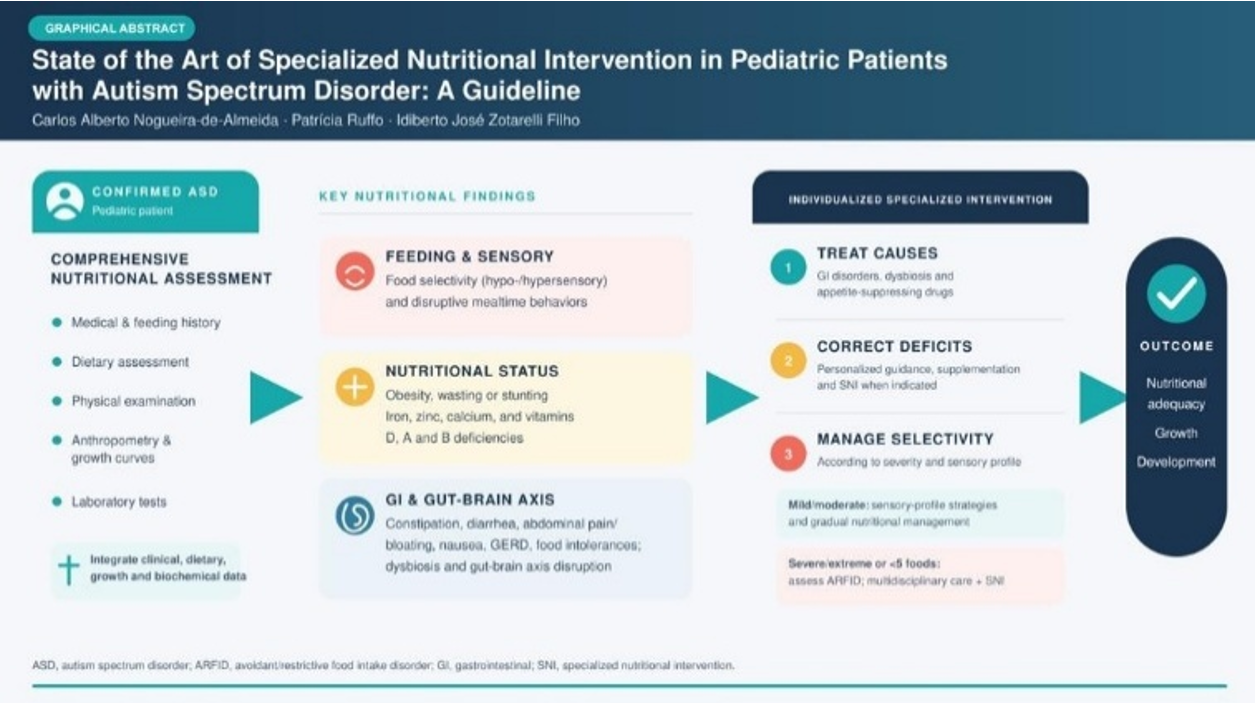
Autism Spectrum Disorder (ASD) is a complex and heterogeneous neurodevelopmental condition. The global prevalence of ASD has increased considerably in recent decades. Recent data from the United States estimate that 1 in 36 children is affected. Among the most significant health-related consequences of ASD are undoubtedly nutritional status disorders. In light of this, the present guideline outlines a nutritional treatment algorithm for ASD, with a focus on specialized nutritional interventions. The proposed algorithm enables an appropriate therapeutic approach that contributes significantly to improved health and quality of life, as well as to reducing family stress. Specialized nutritional intervention is necessary and serves as a simple, efficient method to help resolve a large proportion of nutritional issues in this patient group. Therefore, early nutritional intervention promotes healthier eating habits in children with ASD.

Graphical Abstract
mceclip0-27eaa5d1c273331ad9a83259599bd939.png

How to Cite

Nogueira-de-Almeida, C. A., Ruffo, P., & Zotarelli Filho, I. J. (2026). State of the art of specialized nutritional intervention in pediatric patients with autism spectrum disorder: a guideline. International Journal of Nutrology, 19(3). https://doi.org/10.54448/ijn26318